
Watch Water Resistance Explained: 3ATM vs 5ATM vs 10ATM (What Can You Really Do?)
Don't let a sudden rain shower ruin your timepiece. Here is the definitive breakdown of what watch water resistance ratings mean in the real world—and how to keep your watch sealed forever.

Vikramaditya Rathore
Materials Engineer & Metallurgical Consultant
Published 2025-02-08
Verified for accuracy • 2025

Quick Key Takeaways • At a Glance
- Water resistance ratings are measured under static lab conditions (barometric pressure), not physical depth below the surface.
- 3ATM (30 meters) is only splash resistant—it should never be submerged under a running tap or worn during a swim.
- 5ATM (50 meters) provides true hydrostatic sealing with internal O-rings, safely withstanding swimming, poolside splashes, and heavy monsoon rains.
- Never expose any water-resistant watch to hot water, saunas, or soapy showers, as thermal expansion can compromise rubber gasket seals.
Table of Contents
The Biggest Myth in Horology: What '50m' Really Means
Direct Answer / Summary
A '50m' water resistance rating does NOT mean you can dive 50 meters deep. It means the case withstood 5 atmospheres (approx. 5 bar or 73.5 psi) of static hydrostatic lab pressure. In the real world, 5ATM guarantees safe swimming and monsoon rain resistance.
One of the most confusing aspects of buying a watch is interpreting water resistance ratings. Customers frequently assume that a watch marked '30 meters / 3ATM' can be worn during a 10-meter scuba dive. In reality, doing so will immediately flood the movement.
Water resistance testing—governed by the international standard ISO 22810—is conducted in static, motionless laboratory chambers at room temperature. When you jump into a pool, wave your arms through water, or expose a watch to a pressurized tap stream, dynamic pressure spikes far exceed static lab depths.
Understanding this distinction is the key to protecting your investment for life.
Static vs Dynamic Hydrostatic Pressure
Direct Answer / Summary
Moving your arm vigorously through water or exposing a watch to a pressurized sink faucet generates dynamic pressure surges that are several times higher than calm, still water at the same depth.
Imagine holding your hand out of a car window at 60 km/h: the air exerts significant force against your palm. The same fluid dynamic principle applies to water.
When you dive into a swimming pool or swim freestyle, the arm impact against the water creates transient localized pressure spikes. While a 3ATM watch is certified to hold 3 bars of calm pressure, a forceful swimming stroke can easily spike localized pressure above 3 bars, causing water to breach the crown stem.
This is why horologists consider 5ATM (50 meters) the absolute minimum baseline for any true everyday luxury watch.
Complete Water Resistance Guide (3ATM to 20ATM)
Direct Answer / Summary
Use this straightforward rule: 3ATM for handwashing and light drizzle; 5ATM for everyday swimming, monsoon rains, and shallow waters; 10ATM for snorkeling and water sports; 20ATM+ for scuba diving.
Here is the definitive real-world activity breakdown for each water resistance level:
| Rating | Pressure (Bar/PSI) | Safe Real-World Activities | Prohibited Activities |
|---|---|---|---|
| 3ATM (30m) | 3 Bar / 44 PSI | Accidental splashes, washing hands, light drizzle | Swimming, showering, poolside submersion |
| 5ATM (50m) [KAALOR] | 5 Bar / 73.5 PSI | Recreational swimming, heavy rain, poolside, handwashing | Scuba diving, cliff diving, high-speed jet skis |
| 10ATM (100m) | 10 Bar / 147 PSI | Snorkeling, sailing, surfing, vigorous water sports | Deep scuba diving with gas tanks |
| 20ATM (200m) | 20 Bar / 294 PSI | Professional scuba diving, extreme aquatic expeditions | None (standard marine recreation safe) |
How KAALOR Achieves True 5ATM Hydrostatic Integrity
Direct Answer / Summary
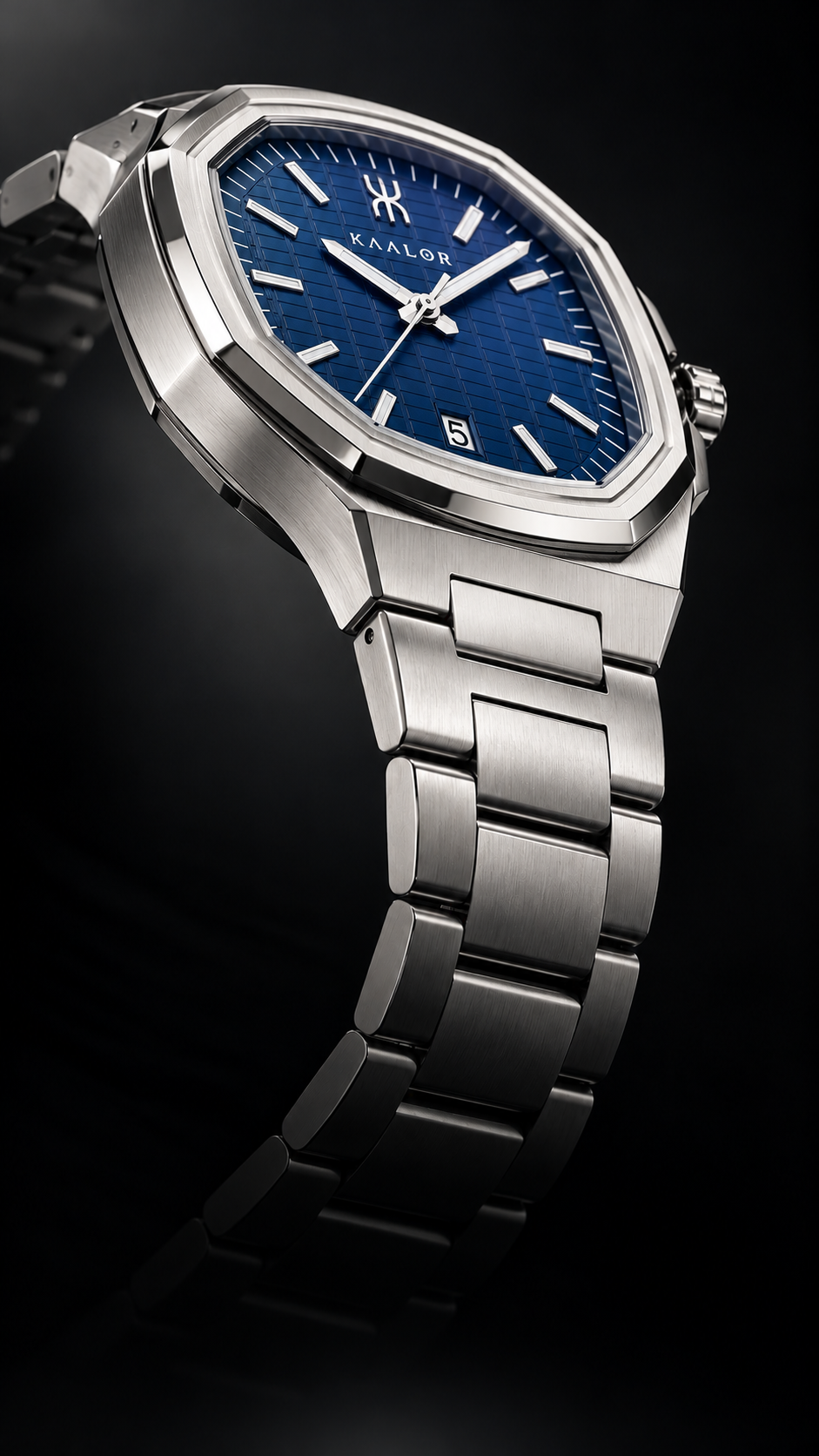
The KAALOR Epoch uses dual-stage synthetic Viton O-rings around the crown stem and a precision-threaded screw-down caseback, with every single watch individually pressure-tested before dispatch.
Many fashion watches simply snap their caseback into place using friction. Over time, opening the watch to change batteries bends the soft metal bezel, destroying any water resistance it once had.
In the KAALOR Epoch Azure Blue, the case architecture incorporates a solid 316L stainless steel screw-down caseback with machined threading. Fitted inside is an industrial-grade Viton fluoroelastomer gasket that maintains elasticity across extreme temperature fluctuations.
Additionally, the crown stem utilizes internal dual O-ring compression seals. Even if the watch is bumped in water, the secondary seal prevents moisture from penetrating the movement chamber.
Golden Rules of Water Care for Luxury Watches
Direct Answer / Summary
Never pull out or operate the crown while wet, rinse with fresh water after swimming in saltwater or chlorine, and avoid hot showers or saunas due to thermal gasket expansion.
To keep your timepiece running flawlessly for decades, observe these three cardinal rules:
1. Never Operate the Crown Underwater: Always ensure the crown is pushed fully flush against the case before entering the water. Operating the crown wet draws moisture straight into the movement.
2. Beware of Hot Steam: Hot showers, saunas, and steam rooms are the number-one killers of luxury watches. Heat causes the steel case and rubber gaskets to expand at different rates, allowing microscopic steam vapor to penetrate and condense on the inside of the crystal.
3. Freshwater Rinse After Saltwater: Ocean salt dries into abrasive micro-crystals that can wear away rubber seals. Always rinse your watch under gentle tap water and pat dry with a soft cloth after beach outings.
The KAALOR Epoch — Azure Blue
Engineered in solid 316L surgical stainless steel with a regulated Japanese movement, 5ATM water resistance, and an industry-leading 5-year atelier warranty.
Frequently Asked Questions
Can I wear my 5ATM watch while taking a hot shower?
No. While 5ATM easily handles cold water and swimming, hot shower steam expands the rubber gaskets and soap residue breaks down the water surface tension, increasing the risk of condensation inside the dial.
What should I do if fog or condensation appears inside the watch crystal?
Condensation indicates moisture has breached the gasket. Immediately place the watch in a sealed airtight bag with silica gel desiccant packs and send it to an authorized watchmaker to dry and service the calibre before rust forms.
How often should watch water gaskets be checked?
For watches worn daily during swimming or active sports, we recommend having the rubber gaskets inspected and lubricated with silicone grease every 2 to 3 years during a battery change.
Is rain safe for a KAALOR watch?
Yes. Every KAALOR timepiece is certified to 5ATM (50 meters) water resistance and is fully impervious to torrential monsoon downpours and everyday handwashing.
Related Horological Dispatches
View All Journal EntriesBest Men's Everyday Luxury Watches in India: The 2025 Practical Guide
Finding a versatile everyday wristwatch in India shouldn't mean choosing between cheap zinc fashion brands and exorbitant Swiss heritage markups. Here is what smart buyers prioritize in 2025.
316L Surgical Stainless Steel vs Base Metal & Zinc Alloy: The Watch Metallurgy Guide
Ever wondered why some watches retain their gleaming showroom finish for 20 years while others pit, tarnish, and irritate your wrist? The secret lies in the atomic metallurgy of 316L steel.