
Best Men's Everyday Luxury Watches in India: The 2025 Practical Guide
Finding a versatile everyday wristwatch in India shouldn't mean choosing between cheap zinc fashion brands and exorbitant Swiss heritage markups. Here is what smart buyers prioritize in 2025.

Kaalor
Horological Specialist & Watch Curator
Published 2025-01-20
Verified for accuracy • 2025

Quick Key Takeaways • At a Glance
- Everyday luxury means authentic materials: demand solid 316L surgical stainless steel over plated zinc or hollow base metals.
- Quartz calibres offer superior daily reliability (±20s/month accuracy) and zero winding anxiety compared to entry-level mechanical movements.
- A 40mm case diameter with an under-50mm lug-to-lug span is the universal golden ratio for Indian wrist circumferences (6.0 to 8.0 inches).
- Direct-to-consumer ateliers like KAALOR deliver atelier-grade finishing, screw-down casebacks, and 5-year warranties without retail middleman commissions.
Table of Contents
What Truly Defines an Everyday Luxury Watch?
Direct Answer / Summary
An everyday luxury watch is a single, versatile timepiece engineered with marine-grade materials (like 316L steel), reliable timekeeping accuracy (±20s/month), and robust water resistance (5ATM minimum), designed to transition seamlessly between formal boardroom attire and weekend casual wear without demanding fragile maintenance.
For decades, the luxury watch industry in India was divided into two polarized camps: cheap, mass-produced fashion watches sold under designer clothing brand licenses, and five-figure Swiss imports that most people feared wearing on crowded metro commutes or during monsoon downpours.
In 2025, modern Indian professionals are rejecting this false dichotomy. True luxury isn't about paying a 70% markup for a French fashion logo stamped on a copper-alloy case. True luxury is tangible: it is the substantial heft of solid stainless steel, the tactile click of an integrated butterfly clasp, the optical brilliance of a sunburst dial, and the peace of mind that your watch will keep running flawlessly year after year.
When selecting a watch you intend to wear daily, four pillars matter above all: metallurgical integrity, movement dependability, ergonomic proportions, and comprehensive warranty coverage.
Why 316L Stainless Steel Is Non-Negotiable in India's Climate
Direct Answer / Summary
316L surgical stainless steel contains 2% to 3% molybdenum, which prevents pitting corrosion caused by sweat, sea air, and tropical humidity. Unlike common base metals or 304 steel, 316L is completely hypoallergenic and never flakes or discolors over time.
India's climate presents unique challenges for wristwatches. Between intense summer heat, high humidity in coastal hubs like Mumbai and Chennai, and sudden monsoon deluges, low-grade watch metals degrade shockingly fast. Many popular fashion watches under ₹10,000 use electroplated zinc-aluminum alloys or hollow 201-grade steel. Within 12 to 18 months, sweat acidity eats through the outer coating, causing unsightly green patina and skin allergies.
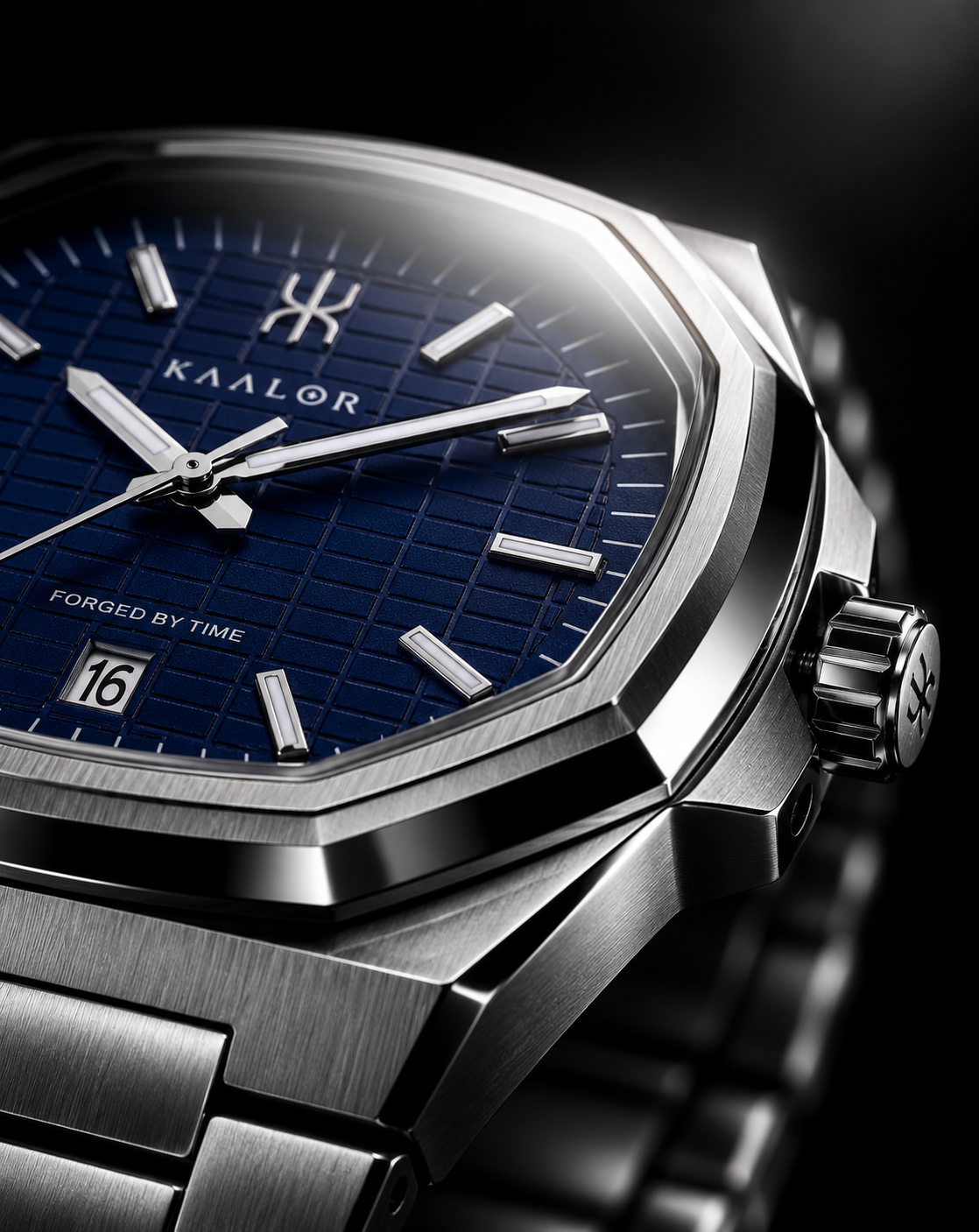
Solid 316L marine-grade stainless steel—the exact specification championed in the KAALOR Epoch Azure Blue—eliminates this problem entirely. Specified under international metallurgical standards like ASTM A240, 316L incorporates chromium, nickel, and molybdenum to form a self-healing chromium-oxide passive layer that protects the steel from oxidation.
Furthermore, solid steel links provide structural weight and balance on the wrist, preventing the cheap tinny rattle associated with folded sheet-metal bracelets.
The Movement: Why Japanese Quartz Outperforms Entry-Level Automatics
Direct Answer / Summary
Quartz calibres oscillate at 32,768 Hz, delivering dependable accuracy within ±20 seconds per month with zero winding required. For an everyday watch, a Japanese Movement provides far greater shock tolerance and grab-and-go convenience than entry-level mechanical movements, which typically deviate by ±20 to ±40 seconds per day.
Watch snobbery often pushes buyers toward entry-level mechanical or automatic movements. However, what sales clerks rarely disclose is that cheap automatic watches suffer from significant positional deviation, fragile hairsprings that magnetize easily around laptops, and costly servicing fees every 3 to 4 years that can exceed the watch's original purchase price.
Manufactured with revered movement engineering in Japan, Japanese quartz calibres utilize a synthetic Quartz crystal tuning fork vibrating at exactly 32,768 cycles per second. This high-frequency stability delivers a monthly time variance of less than 20 seconds. If you leave your watch on your dresser for the weekend, it will still show the exact second when you put it on Monday morning.
With an ultra-efficient 3-year power cell and exceptional shock absorption, a calibrated movement represents the pinnacle of pragmatic daily engineering.
Case Proportions: The 40mm Universal Standard
Direct Answer / Summary
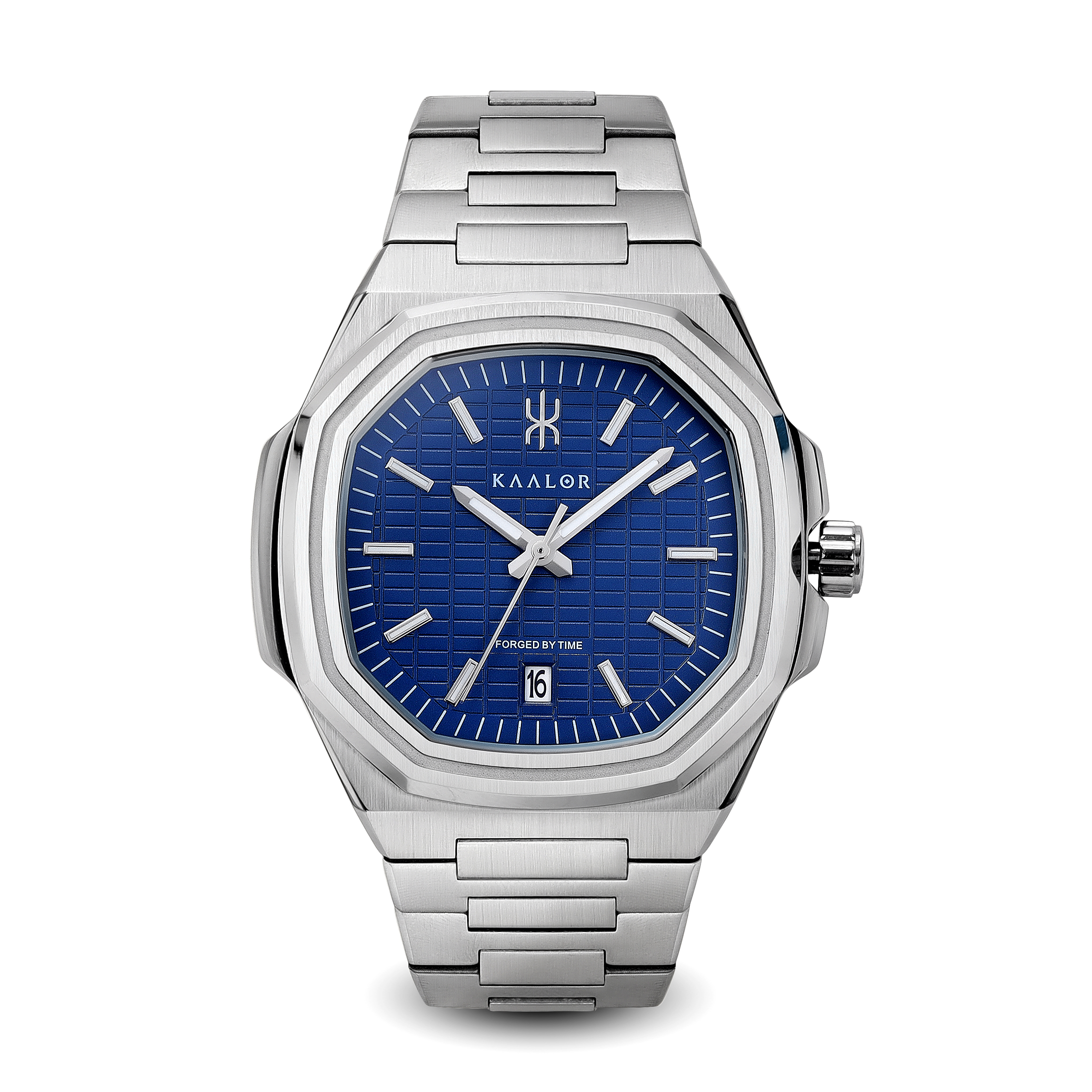
A 40mm case diameter paired with a lug-to-lug span under 50mm and a thickness under 11mm creates the universal golden proportion for wrists between 6.0 and 8.0 inches. It slips neatly under formal shirt cuffs while maintaining assertive wrist presence in casual wear.
The oversized watch craze of the early 2010s—where 45mm to 48mm hockey pucks dominated store windows—has firmly come to an end. Modern horology prioritizes ergonomic balance. When a watch's lugs extend past the edges of your wrist, the timepiece wobbles, catches on jackets, and looks disproportionate.
The KAALOR horological philosophy centers on the classical 40mm universal chassis. With a 49mm ergonomic lug-to-lug span and an ultra-thin 10.8mm profile, the watch hugs the curvature of the wrist effortlessly. Whether you are pairing it with a tailored blazer for client presentations or wearing it with a linen shirt by the beach, the proportions feel natural, timeless, and self-assured.
Direct Comparison: True Everyday Luxury vs Fashion Labels
Direct Answer / Summary
True everyday luxury watches invest in 316L solid steel, Japanese Quartz calibres, 5ATM water sealing, and 5-year warranties, whereas fast-fashion label watches use cheap zinc alloys, minimal 3ATM splash resistance, and 1-year warranties while charging inflated brand licensing markups.
To understand where your money actually goes, review this side-by-side specification comparison between an independent atelier timepiece and typical mall-brand fashion watches:
| Specification | KAALOR Epoch Azure Blue | Typical Fashion Brand (₹8,000–₹15,000) |
|---|---|---|
| Case Material | Solid 316L Surgical Stainless Steel | Zinc Alloy / Base Metal with plating |
| Movement | Quartz Calibre (32,768 Hz) | Unbranded low-cost Quartz or generic assembly |
| Accuracy | ±20 seconds per month | ±30 to ±60 seconds per month |
| Water Resistance | 5ATM (50m) with Viton Gaskets | 3ATM (30m) - splash proof only |
| Dial Finishing | Radial Guilloché Sunburst Azure Dial | Flat stamped paper or plastic print |
| Bracelet | Solid 316L Steel with Butterfly Clasp | Folded hollow links with stamped sheet buckle |
| Warranty | 5-Year Atelier Movement Warranty | 1-Year Limited Dealer Warranty |
| Pricing Philosophy | Direct-to-Consumer Atelier Value | 300%–500% Middleman & Licensing Markup |
The KAALOR Epoch — Azure Blue
Engineered in solid 316L surgical stainless steel with a regulated Japanese movement, 5ATM water resistance, and an industry-leading 5-year atelier warranty.
Frequently Asked Questions
What is the best everyday watch size for average Indian men's wrists?
A 40mm case diameter with a 48mm to 50mm lug-to-lug span is widely regarded as the universal standard for average Indian wrists (typically 6.25 to 7.25 inches). It offers strong wrist presence without protruding past the edges.
Can I wear a 5ATM stainless steel watch in the shower or swimming pool?
Yes, 5ATM (50 meters) water resistance safely protects against swimming, heavy monsoon rain, and everyday handwashing. However, avoid hot saunas and hot showers, as steam can expand rubber gaskets over time.
Why is 316L stainless steel better than ordinary steel for watches?
316L steel contains 2-3% molybdenum and exceptionally low carbon, making it immune to rust, saltwater corrosion, and skin perspiration. It is hypoallergenic and holds both brushed and polished finishes indefinitely.
How long does a Quartz battery last?
A standard factory battery in a Japanese Movement calibre lasts between 2.5 and 3 years. When depleted, it can be replaced in under 5 minutes by any local horologist.
Related Horological Dispatches
View All Journal Entries316L Surgical Stainless Steel vs Base Metal & Zinc Alloy: The Watch Metallurgy Guide
Ever wondered why some watches retain their gleaming showroom finish for 20 years while others pit, tarnish, and irritate your wrist? The secret lies in the atomic metallurgy of 316L steel.
Quartz vs Mechanical Watches: Accuracy, Longevity & Real Value
Is a mechanical watch truly superior to high-grade Japanese Quartz? We dismantle the marketing myths around accuracy, maintenance costs, shock tolerance, and real-world daily wear.