
316L Surgical Stainless Steel vs Base Metal & Zinc Alloy: The Watch Metallurgy Guide
Ever wondered why some watches retain their gleaming showroom finish for 20 years while others pit, tarnish, and irritate your wrist? The secret lies in the atomic metallurgy of 316L steel.

Vikramaditya Rathore
Materials Engineer & Metallurgical Consultant
Published 2025-01-28
Verified for accuracy • 2025
Quick Key Takeaways • At a Glance
- 316L stainless steel contains 16-18% chromium, 10-14% nickel, and 2-3% molybdenum, creating unmatched resistance against sweat corrosion and pitting.
- The 'L' stands for Low Carbon (under 0.03%), which eliminates carbide precipitation during welding and precision CNC milling.
- Cheap fashion watches use electroplated zinc alloy (Zamak) or 201 steel, which degrades within months in hot and humid climates.
- Solid 316L steel can be repeatedly polished, brushed, and refinished throughout decades of daily wear.
Table of Contents
What Exactly is 316L Surgical Stainless Steel?
Direct Answer / Summary
316L is an austenitic stainless steel alloy composed of iron, 16–18% chromium, 10–14% nickel, 2–3% molybdenum, and less than 0.03% carbon. It is certified for biomedical implants, marine instruments, and luxury horology due to its supreme corrosion resistance.
Stainless steel is not a single uniform material. There are over 150 distinct commercial grades of steel, ranging from inexpensive architectural rebar to surgical-grade implants. In luxury horology, one specific alloy reigns supreme: AISI 316L.
The '300 series' denotes austenitic steels, which possess a crystal structure that remains non-magnetic and highly ductile. The 'L' designation is critical—it specifies an ultra-low carbon threshold (less than 0.03%). This low carbon content prevents chromium carbide formation along grain boundaries during manufacturing, ensuring the metal maintains uniform corrosion resistance throughout the entire cross-section of the case.
When you hold a KAALOR Epoch timepiece, every single structural component—from the three-piece 40mm case chassis to the solid articulated bracelet links—is CNC milled from solid billets of certified 316L steel.
Molybdenum: The Secret Weapon Against Sweat & Salt
Direct Answer / Summary
Molybdenum (2–3%) strengthens the protective chromium-oxide layer on the steel's surface, preventing chloride ions present in human perspiration and ocean saltwater from creating microscopic pits and stress cracks.
Standard stainless steel (such as grade 304, used in household kitchenware) relies solely on chromium to resist atmospheric rust. When chromium reacts with oxygen, it forms an invisible protective barrier known as chromium(III) oxide.
However, human sweat is acidic and rich in chloride salts. Under tropical heat or during physical exertion, chloride ions penetrate ordinary steel's oxide barrier, initiating a destructive microscopic process called pitting corrosion. Within a few months, small black specks form on the back of the watch case.
By contrast, 316L includes 2.0% to 3.0% molybdenum. Molybdenum binds tightly with the passive oxide film, dramatically raising the Pitting Resistance Equivalent Number (PREN) from approximately 18 (for 304 steel) to over 24. This makes 316L completely impervious to sweat acidity, coastal humidity, and chlorinated pool water.
316L Steel vs Zinc Alloy (Zamak) & 304 Steel
Direct Answer / Summary
Zinc alloy (Zamak) is a low-melting-point casting metal coated with thin electroplating that flakes off easily. Grade 304 steel lacks molybdenum and rusts against sweat. Only solid 316L surgical steel guarantees lifelong structural integrity.
To illustrate why case metallurgy determines the longevity of your timepiece, here is how common watch materials compare across physical metrics:
| Property | 316L Surgical Steel (KAALOR) | Standard 304 Steel | Zinc Alloy / Brass (Zamak) |
|---|---|---|---|
| Corrosion Resistance | Exceptional (Marine Grade) | Moderate (Vulnerable to sweat) | Very Poor (Depends on plating) |
| Molybdenum Content | 2.0% – 3.0% | 0% | 0% |
| Carbon Level | < 0.03% (Low Carbon) | ~ 0.08% (Higher carbon) | N/A (Non-ferrous alloy) |
| Tensile Strength | 485 – 620 MPa | 515 MPa | 280 – 330 MPa |
| Vickers Hardness | ~ 220 HV (Scratch Resisting) | ~ 180 HV | ~ 90 – 120 HV (Soft) |
| Hypoallergenic Safety | Biocompatible (Surgical standard) | Moderate (May leach nickel) | Poor (Causes green skin staining) |
| Finish Durability | Can be polished for decades | Can be re-polished | Plating wears off permanently |
Dual Surface Finishing: Satin Brushing & Mirror Chamfers
Direct Answer / Summary
316L steel possesses the ideal crystalline density to accept alternating surface finishes: linear satin brushing on flat planes to diffuse scuffs, contrasted with high-polish mirror bevels on curved edges to reflect ambient light.
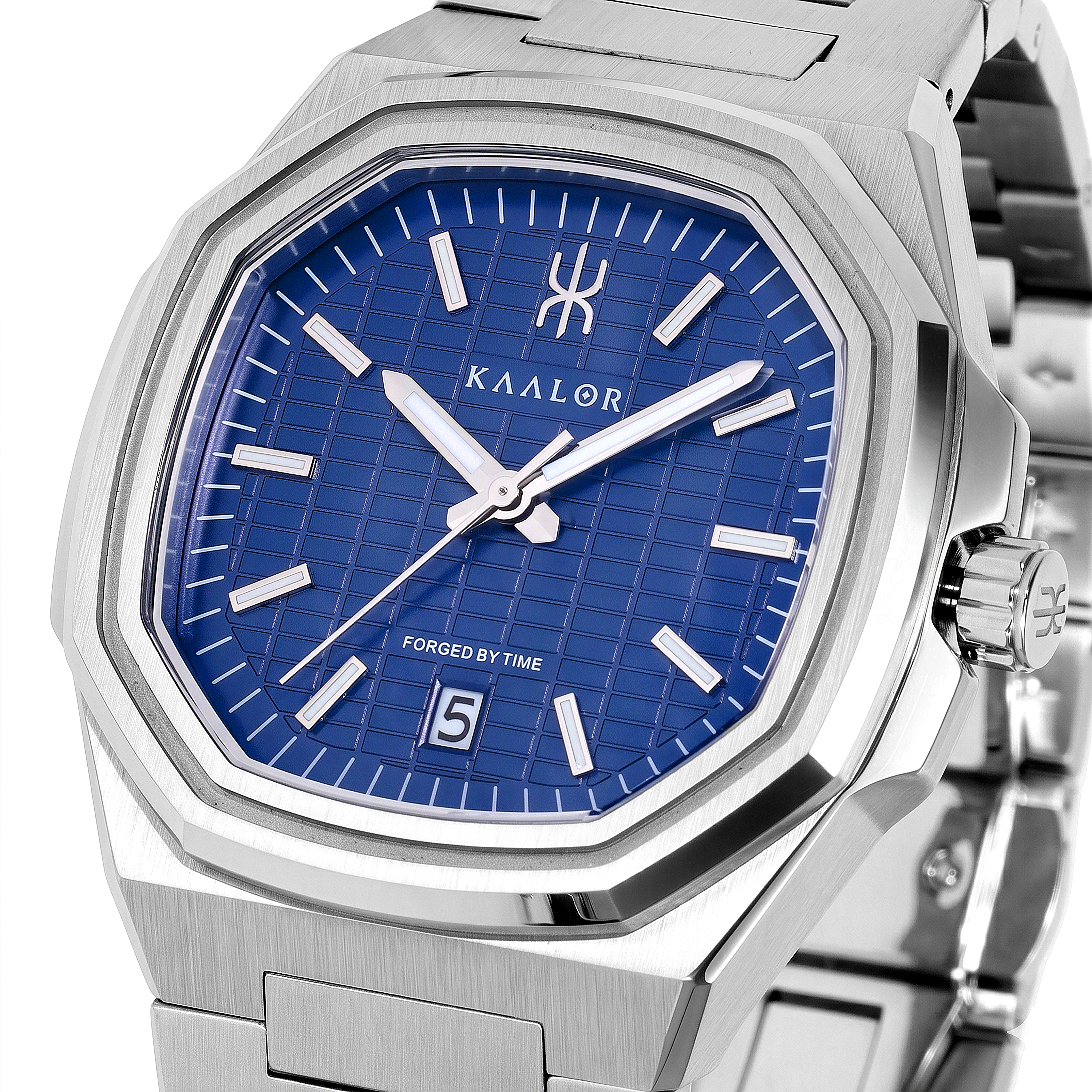
The hallmark of high horology is the juxtaposition of contrasting surface textures. On the KAALOR Epoch Azure Blue, the top surfaces of the lugs and bezel feature fine directional satin brushing. This matte texture suppresses glare and hides everyday hairline scratches.
Simultaneously, the case flanks and faceted lug edges are hand-polished to a distortion-free optical mirror shine. Achieving this crisp contrast requires exceptional metallurgical hardness—softer metals like zinc or tin-plated brass simply round off and blur during diamond polishing.
The result is a dynamic interplay of light: as your wrist turns, crisp specular highlights run along the bevelled contour of the watch, creating a luxurious architectural presence.
Why 316L Is Completely Hypoallergenic on Sensitive Skin
Direct Answer / Summary
Because 316L steel locks nickel firmly within its austenitic crystal lattice, it does not release nickel ions onto the skin. This biocompatibility meets EU Nickel Directive standards, eliminating contact dermatitis and sweat rashes.
According to dermatological studies, nickel allergy (allergic contact dermatitis) affects approximately 10% to 15% of the population. When low-grade metals react with perspiration, nickel ions dissolve and penetrate the epidermis, causing red, itchy, and irritated wrists.
In 316L surgical steel, the high chromium and molybdenum content binds the nickel atoms securely within a stable face-centered cubic (FCC) lattice. Nickel release rates from 316L are well below the strict 0.5 µg/cm²/week threshold mandated by the European Nickel Directive (EN 1811).
This is why 316L is used in orthopedic bone screws and surgical instruments—and why you can wear a KAALOR watch all day in high heat with complete skin comfort.
The KAALOR Epoch — Azure Blue
Engineered in solid 316L surgical stainless steel with a regulated Japanese movement, 5ATM water resistance, and an industry-leading 5-year atelier warranty.
Frequently Asked Questions
Does 316L stainless steel ever rust?
Under normal atmospheric conditions, freshwater, saltwater, and human sweat, 316L stainless steel will never rust due to its self-healing chromium-molybdenum oxide passive film. Only concentrated industrial acids can compromise it.
What is the difference between 316L and 904L steel?
904L steel contains slightly higher nickel and copper levels for specialized sulfuric acid resistance. However, 316L has superior scratch resistance (higher Vickers hardness) and remains the global gold standard for 99% of luxury sports watches.
Can I remove scratches from a 316L steel watch?
Yes. Because the watch is solid steel throughout rather than surface plated, light hairline scratches can be easily removed by a professional jeweller using micro-abrasive polishing wheels without exposing base metals.
Why do some cheap watches turn your skin green?
Cheap watches made of brass, copper, or zinc alloys react with sweat to form copper carbonate and zinc salts, which leave a greenish-black stain on the skin. Solid 316L steel never causes discoloration.
Related Horological Dispatches
View All Journal EntriesBest Men's Everyday Luxury Watches in India: The 2025 Practical Guide
Finding a versatile everyday wristwatch in India shouldn't mean choosing between cheap zinc fashion brands and exorbitant Swiss heritage markups. Here is what smart buyers prioritize in 2025.
Quartz vs Mechanical Watches: Accuracy, Longevity & Real Value
Is a mechanical watch truly superior to high-grade Japanese Quartz? We dismantle the marketing myths around accuracy, maintenance costs, shock tolerance, and real-world daily wear.