
Quartz vs Mechanical Watches: Accuracy, Longevity & Real Value
Is a mechanical watch truly superior to high-grade Japanese Quartz? We dismantle the marketing myths around accuracy, maintenance costs, shock tolerance, and real-world daily wear.

Kaalor
Horological Specialist & Watch Curator
Published 2025-02-02
Verified for accuracy • 2025

Quick Key Takeaways • At a Glance
- A calibrated Quartz calibre oscillates at 32,768 Hz, achieving ±20 seconds per month accuracy compared to ±15 to ±30 seconds per day for entry automatics.
- Quartz movements have fewer moving mechanical gears, making them substantially more shock-tolerant against drops, gym workouts, and daily impacts.
- Mechanical watches require complete disassembly and lubrication every 3 to 5 years, often costing ₹4,000 to ₹10,000 per service.
- For everyday dependability and grab-and-go convenience, Quartz remains the benchmark of modern horological utility.
Table of Contents
The Physics of Time: How a Quartz Resonator Works
Direct Answer / Summary
A Quartz movement uses an integrated circuit that sends small electric pulses to a synthetic Quartz crystal tuning fork, causing it to vibrate precisely 32,768 times per second. A digital frequency divider steps this vibration down to exactly one impulse per second to drive the stepper motor.
In 1969, the horological world changed forever with the invention of the Quartz wristwatch. At the heart of this revolution was the piezoelectric effect: when an electric current from a miniature silver-oxide cell is applied to a synthetic Quartz crystal, it oscillates at a remarkably stable harmonic frequency of 32,768 Hz (2¹⁵ vibrations per second).
By comparison, traditional mechanical watches rely on a coiled mainspring that uncoils through an escapement wheel and balance spring, oscillating at just 3 to 4 Hz (21,600 to 28,800 beats per hour). Because Quartz oscillates nearly 10,000 times faster, its resistance to external gravity, temperature swings, and physical motion is mathematically superior.
Inside every KAALOR Epoch timepiece, a factory-regulated Japanese Movement translates this harmonic perfection into reliable second-by-second precision.
Accuracy Showdown: ±20 Seconds per Month vs ±20 Seconds per Day
Direct Answer / Summary
Japanese Movement quartz watches deviate by at most ±20 seconds over an entire 30-day month. In contrast, entry-level automatic watches have factory tolerances of -20 to +40 seconds per day, requiring weekly resetting.
Marketing campaigns for automatic watches often speak of romantic ticking escapements, but they rarely mention the daily inconvenience of time drift. An entry-level automatic watch running at +25 seconds per day will be almost 3 minutes fast by the end of a single week.
Furthermore, automatic movements have an average power reserve of only 38 to 42 hours. If you remove your automatic watch on Friday evening, you will find it completely dead by Sunday afternoon. You must then manually unscrew the crown, wind the spring, reset the time, and set the date before heading out.
With a Quartz watch, you pick it up, strap it to your wrist, and know with absolute certainty that the time is accurate to the exact minute.
The Hidden Costs of Mechanical Watch Maintenance
Direct Answer / Summary
Mechanical movements contain over 130 micro-components that require ultrasonic cleaning, fresh synthetic oils (Moebius), and gasket replacement every 3 to 5 years, costing thousands of rupees. Japanese Movement quartz watches only require a 5-minute battery swap every 3 years.
Ownership cost is an essential consideration for discerning watch buyers. Consider what happens over a 10-year period:
| Metric | Quartz (KAALOR) | Entry-Level Automatic Watch |
|---|---|---|
| Frequency | 32,768 Hz | 3 – 4 Hz (21,600 – 28,800 bph) |
| Monthly Deviation | ±15 to ±20 seconds / month | ±300 to ±600 seconds / month |
| Power Source | 3-Year Silver-Oxide Battery | Mainspring (38–42 hour reserve) |
| Weekend Survival | Runs uninterrupted for 3 years | Stops dead after ~40 hours on nightstand |
| 10-Year Service Cost | Approx. ₹600 (3 battery swaps) | Approx. ₹12,000–₹18,000 (2 to 3 full services) |
| Magnetic Resistance | Extremely High (IC shielded) | Low (Hairspring can stick if near phone/laptop) |
| Warranty Backing | 5-Year Atelier Warranty | Typically 1 to 2 Years |
Shock Resistance: Why Quartz Handles Real Life Better
Direct Answer / Summary
Because Quartz movements contain no fragile balance staff pivots or delicate hairsprings, they can absorb sudden shocks from bike rides, tennis, or accidental drops that would shatter or misalign a mechanical watch.
In a mechanical watch, the entire timekeeping mechanism balances on microscopic pivot pins that are fractions of a millimeter thick. A sharp bump against a doorframe, a hard tennis serve, or riding a motorcycle over rough pavement can easily bend the balance staff or cause the hairspring coils to tangle.
In contrast, a modern Quartz calibre utilizes an electronic integrated circuit and a high-torque miniature stepper motor encased in durable shock-absorbing polymer mounts.
Whether you are traveling, working out, or running daily errands, a Quartz timepiece withstands real-world shocks with effortless resilience.
The Heritage of Japanese Movement Engineering
Direct Answer / Summary
Renowned globally for producing hundreds of millions of ultra-reliable calibres, Japanese movement engineering is trusted by independent watchmakers worldwide for its exceptional precision and durability.
Watch connoisseurs recognize that Japanese horology has equalled—and in many areas surpassed—Swiss manufacturing in precision automation and micro-engineering. State-of-the-art movement facilities in Japan operate under strict robotic cleanroom tolerances, ensuring that every gear train is microscopically deburred and every circuit is sealed against humidity.
By selecting a Japanese Movement as the engine for the KAALOR collection, we ensure that our collectors receive world-class, globally serviceable calibres backed by over six decades of Japanese horological mastery.
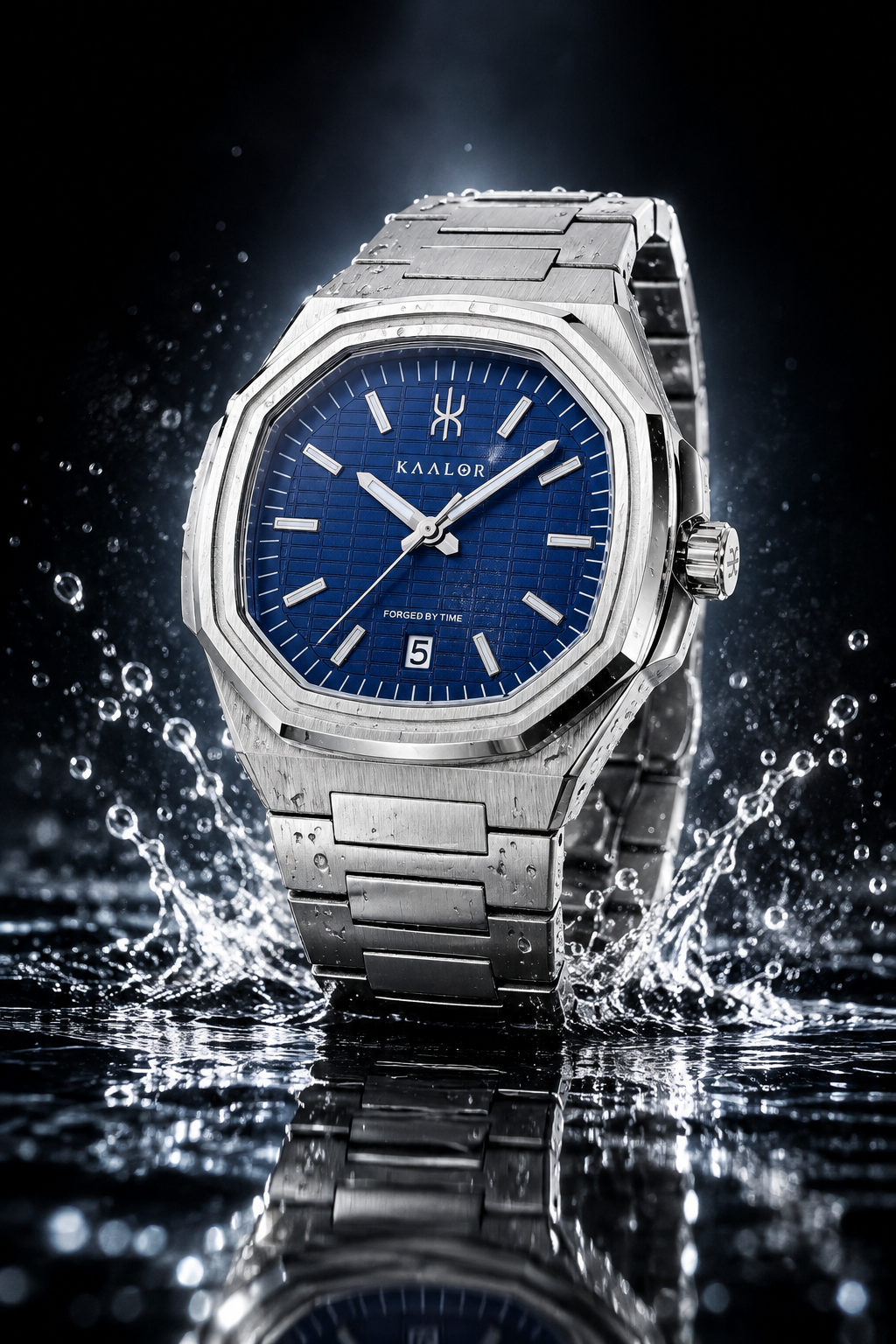
The KAALOR Epoch — Azure Blue
Engineered in solid 316L surgical stainless steel with a regulated Japanese movement, 5ATM water resistance, and an industry-leading 5-year atelier warranty.
Frequently Asked Questions
Why do watch purists still buy mechanical watches?
Watch enthusiasts appreciate mechanical watches as miniature kinetic art—the fascination of coiled springs, oscillating balance wheels, and sweeping seconds hands. However, for everyday reliability and accuracy, Quartz is technically superior.
Why choose a Japanese movement?
Japanese movement manufacturing is globally renowned for world-class precision automation, extreme reliability, and effortless grab-and-go accuracy backed by decades of horological mastery.
Does a Quartz watch lose accuracy as the battery drains?
No. The Quartz crystal vibrates at an exact frequency until the battery voltage drops below the operating threshold of the integrated circuit. At that point, the seconds hand skips in 2-second intervals as an End-of-Life (EOL) indicator.
How often should I change the battery in my KAALOR watch?
The factory Japanese battery typically lasts 2.5 to 3 years. Any watch repair shop can replace the silver-oxide cell in a few minutes without affecting water seals when serviced properly.
Related Horological Dispatches
View All Journal EntriesBest Men's Everyday Luxury Watches in India: The 2025 Practical Guide
Finding a versatile everyday wristwatch in India shouldn't mean choosing between cheap zinc fashion brands and exorbitant Swiss heritage markups. Here is what smart buyers prioritize in 2025.
316L Surgical Stainless Steel vs Base Metal & Zinc Alloy: The Watch Metallurgy Guide
Ever wondered why some watches retain their gleaming showroom finish for 20 years while others pit, tarnish, and irritate your wrist? The secret lies in the atomic metallurgy of 316L steel.